Gurdi
Community-Legende
Nope, nix konkretes.
Selbst wenn kann man sich kaum drauf verlassen auf dem aktuellen Markt.

Nope, nix konkretes.

Bei BF4 zum Beispiel hab ich doch noch diese Cuts. Karte läuft aber trotz ~1475mhz @ 1000mV laut Wattman in die 84 Grad regelung.

Selbst wenn kann man sich kaum drauf verlassen auf dem aktuellen Markt.

Keine Verbesserungen durch den Treiber messbar bei mir.
AMD hat ein Update der GPU Services (AGS 5.1.1) veröffentlicht. Dieses enthält einige interessante Neuerungen, die bald auch den Weg in Spiele und andere Anwendungen finden sollen. Die AGS-Bibliothek bietet Entwicklern alle notwendigen Informationen für die Umsetzung der entsprechenden Funktionen in der eigenen Software. Die entsprechenden Funktionen sind nicht über die Grafik-APIs wie DirectX 11, DirectX 12 oder Vulkan verfügbar, sondern müssen direkt angesprochen werden.
Zu den unterstützten Funktionen gehört FreeSync 2. Mit FreeSync 2 will AMD das Tone Mapping direkt auf der GPU ausführen. Dies soll Verzögerungen bei der Signalübertragung bzw. dem Signalprocessing verringern. Mit FreeSync 2 kommt HDR eine besondere Rolle zu und Low Framerate Compensation (LFC) wird zur Pflicht. FreeSync 2 wurde vor gut sechs Monaten offiziell vorgestellt. Derzeit sind aber nur einige wenige Monitore von Samsung erhältlich, die FreeSync 2 unterstützen. In den kommenden Monaten sollen aber weitere Modelle erscheinen. Für eine ideale Unterstützung ist mit dem AGS 5.1.1 nun die Grundlage geschaffen, damit Entwickler für FreeSync 2 entwickeln können.
Die sogenannten Shader Intrinsics spielen im AGS 5.1.1 ebenfalls eine wichtige Rolle. Die Shader Intrinsics sollen es Entwicklern ermöglichen, an den Grafik-APIs vorbei direkt auf der Hardware bestimmte Funktionen auszuführen. Damit gehen die Shader Intrinsics noch einen Schritt weiter als Vulkan oder DirectX 12, die schon deutlich weniger Overhead besitzen. Shader Intrinsics werden von der letzten Polaris-Architektur und der Vega-Architektur unterstützt. Offen ist noch die Frage, welchen Einfluss sie haben. Unter bestimmten Bedingungen können einzelne Funktionen 10, 20, 50 % oder gar doppelt so schnell ausgeführt werden. Dies muss nicht heißen, dass sich die Bilder pro Sekunde im gleichen Maße erhöhen. Zusammenfassend bleibt nur abzuwarten, welchen Einfluss die Shader Intrinsics haben werden.
AMD GPU Services mit FreeSync 2 und Shader Instrinsics - Hardwareluxx
Eingebundener InhaltAn dieser Stelle findest du externe Inhalte von Youtube. Zum Schutz deiner persönlichen Daten werden externe Einbindungen erst angezeigt, wenn du dies durch Klick auf "Alle externen Inhalte laden" bestätigst: Ich bin damit einverstanden, dass mir externe Inhalte angezeigt werden. Damit werden personenbezogene Daten an Drittplattformen übermittelt.
Für mehr Informationen besuche die Datenschutz-Seite.

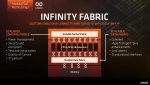
A few years back, AMD acquired SeaMicro with some change it had in the bank, and it did so for the single purpose of buying SeaMicro’s technology that they were going to use to compete against Intel: Freedom Fabric. SeaMicro’s fabric had some caveats that worked against its adoption, though. Systems integrators using it needed external processors to handle all the load, and there wasn’t any existing infrastructure to support it. The original idea was that motherboard vendors would design these XL-ATX motherboards that just had slots on them, and several daughter boards carrying a GPU, CPU, RAM, and networking capabilities.
The fabric was an agnostic solution because it would work with any chipset, any CPU, and any GPU out there, but the proprietary interface and cost of adoption saw very few partners jumping in. AMD saw the potential to integrate this into their Heterogeneous Systems Architecture, and the result almost five years later is Infinity Fabric.
Now located on-die within the Zen and Bristol Ridge cores (and, I presume, into Vega as well), it is able to deliver full-speed bi-directional communication between any two or more processing nodes, which means that it is also capable of allowing communication between AMD’s core complexes (CCX) inside Ryzen. The fabric is also what’s going to enable the Vega and Navi GPU cores to talk to the high-bandwidth cache controller and video outputs, as well as allowing a direct channel to the GPU over PCI Express. Two versions of this exist in Ryzen – one fabric to control the data streams between the CPU and GPU cores and the local memory pool, and one to control every other part of the system.
In AMD’s multi-socket server designs coming this year, Infinity Fabric is extended beyond the CPU socket and will allow communication between each processor, or from one processor to a GPU linked to the same fabric. Shown above is an example of a triple-socket system that can hold up to three Zen-based processors. However, you may be confused by AMD’s use of the term “socket” when referring to other linked nodes in the fabric. The fabric doesn’t differentiate between a GPU that is on-die, or attached via PCIe, so for all intents and purposes a connected GPU would just be treated as another processor in a different socket.
It’s a little clunky, but this is the same basic design that Freedom Fabric had, only it now has the full backing of a company that can sell an integrated solution.
http://www.nag.co.za/2017/05/19/amd...p-epyc-radeon-vega-frontier-edition-and-more/
Hello, my name is Theresa Chavez and I am on the Corporate Communications team at AMD. Just to confirm, Infinity Fabric and the SeaMicro Freedom Fabric are not one in the same thing. In fact, they are totally unrelated.Just wanted to clear that up.
Gern, interessiert mich ja auch.Interessante Beiträge, danke yummy.

WTF? Wieso springen einige Custom Hersteller ab? Zuerst MSI, jetzt Gigabyte...
Kein Custom-Modell der Radeon RX Vega 64 von Gigabyte - Hardwareluxx

WTF? Wieso springen einige Custom Hersteller ab? Zuerst MSI, jetzt Gigabyte...
Kein Custom-Modell der Radeon RX Vega 64 von Gigabyte - Hardwareluxx