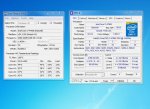
1,4 V auf 4790K????

al_latto

Kabelverknoter(in)
Moin zusammen,

habe gestern mien ganzes neues Geraffel bekommen, eingebaut, und nachdem nun alles flüssig läuft schaue ich mir mal die Tmeps etc. an und finde das doch recht hoch.

Unbenannt-2 Kopie.jpg

Speziell die Vcore macht mir sorgen. Kann ich die im UEFI runterschrauben, welcher Wert wäre für einen 4790K @stock ok - 1,1V??

Danke

Beste gRüße
 
Da die dinger eh so gut wie immer dank den Boards auf allen Kernen mit 4.4GHz laufen würde ich mal so 1.2V anpeilen. Ein Freund hat seinen i7-4790K auch bekommen und da hab ich gestaunt das da 1.3V angelegt waren, und diese erstmal auf 1.1V Runtergeregelt ;) Aber wie immer gilt jede CPU ist anders und braucht unterschiedlich viel/wenig Vcore.
 
Flash erst einmal das neueste Bios. Kannst du unter M.I.T/Advanced Voltage Settings/ CPU Core Voltage Control einstellen. Steht aber auch alles im Handbuch auf Seite 42! Teste mal mit 1,17V, sollte funktionieren.
 
Ich muss jetzt wirklich doof fagen, ist echt ne Ewigkeit her, dass ich ein Bios geflasht habe.

Wie vorgehen??

Ich habe mir die Dateien bereits runtergeladen, auf USB Stick ziehen, neu Booten, F8 in die Eingabeaufforderung und den Flashbefehl ausführen???
 
Das Problem hatte ich auch. Mit aktuellem UEFI wird die Spannung richtig eingestellt. Du musst mit eingestecktem USB-Stick ins UEFI und kannst dann da die neue Version laden. Ist ganz einfach.
 
Nach dem Update werden wohl so ca. 1,25V unter Last anliegen. Kannst dann wie gesagt im Bios mal 1,17V einstellen und testen. Alle i7 4790K die ich bisher hatte liefen bei 4.4GHz mit 1,159V - 1,17V stabil.
 
Spitze. Hat geklappt. jetzt liegen unter Last 1,20V an - ohne dass ich was eingestellt habe. Teste jetzt mal mit BF4 und schaue dann

Wie immer, Das Board ist Spitze. DANKE an euch!!!

Beste grüße
Latto
 
EIn Board das von sich aus so viel Spannung anlegt kann nicht Sptize sein. Das Board ist einfach nur teuer. Ob du noch Hudelein bekommst mit dem Creative Chip würde ich nicht ausschließen. Die PCI Lanes am unteren Ende sind auch nicht zukunftsweisend. Es ist ein billiges Board, das mit Name Sniper auf teuer getrimmt wurde.
 
Hier Gigabyte G1 Sniper Z97 Review - Page 5 of 16 - Play3r war es das einzige Mainboard dass 5 GHz geschafft hat. Das hat auch ein ASRock Z97 Extreme 6 nicht geschafft.

einzeltests sagen aber nicht viel aus, das darf man nicht vergessen, sonst müssten nach intels tests/vorstellung/marketing blabla, alle mit lukü locker 5,6ghz packen ;).

die baugleiche spannungsversorgung bekommt man auch auf einem z87x ud3h und das deutlich günstiger^^

mfg
 
Hier Gigabyte G1 Sniper Z97 Review - Page 5 of 16 - Play3r war es das einzige Mainboard dass 5 GHz geschafft hat. Das hat auch ein ASRock Z97 Extreme 6 nicht geschafft.
Was soll den der sinnlose Beitrag jetzt? - Glaubst du das das Board deswegen gut ist? Weil er die LLC frei gegeben hat. "This was achievable with 1.4v, changing the LLC (load line calibration) to the highest setting and boom, the Gigabyte G1 Sniper Z97 managed to hit 5GHz."

This thread is intended to be an introduction to what LLC is actually doing, and why you should use it with care.

Background on LLC:

For those of you who don't really know what LLC is: LLC was a featured added to motherboards several generations ago to combat vdroop. Vdroop is a drop in voltage supplied to the CPU as load increases; basically when you go from idle to load, the voltage would decrease. Given the small voltage tolerance that overclockers are working with (increased voltage is proportional to the CPU frequency/multiplier that an overclock can achieve), a droop in voltage applied to CPU can make a theoretically stable overclock unstable (dropping the voltage below that required to achieve the set frequency). LLC applies additional voltage to the CPU to combat vdroop so that when switching to load, there is sufficient voltage to keep that frequency stable. So LLC is great and you want to turn it on? Yes, but...

For most modern motherboards, there are different levels of LLC that you can set in your bios. At certain levels of LLC (these may be different for each motherboard), the LLC can overcompensate for this vdroop, and actually apply vboost. Vboost is when the voltage actually supplied to the CPU is above the value that you set in your bios. This can be a nice way of ensuring that your overclock will be stable, but you have to be careful, because each CPU has a death voltage (the voltage where, if applied to your CPU, it will likely die). If you are toeing the line near your CPU's death voltage to try to squeeze every last MHz out of your overclock, LLC can bring your actual voltage above this level, which is a great way of killing your CPU (or making it degrade much faster). So although LLC is great for overclockers, it should be used with care, because you may just end up killing your CPU.

Load-Line Calibration: why overclockers should care - CPUs, Motherboards, and Memory - Linus Tech Tips

Was genau hat nun der Tester gemacht, er hat die Grundspannung der Vcore auf 1,4V (das wird bei 24/7 Betrieb wohl nix außer ggf unter Wasser und selbst dann ist es für Haswell schon hoch) gestellt und der LLC gesagt gib Gummi, damit der Takt hält. Das liebt so eine CPU. Auf dem 8Phasen digital Board mit seinen kleinen Kondensatoren hätte er auch sich gut und gern die CPU zerschmoren können und das feierst du, als gelungen?

Mal davon ab ist die LLC je nach Hersteller unterschiedlich. Mich würde nicht wundern, wenn da der Tester mit Asrock genau falsch rum seinen Test gemacht hat. Und dort die LLC auf 0 gestellt hat bei seinem 1,4V Test. Aber das ist eine Annahme die einer Unterstellung gleich kommt und so nicht zu halten ist, da der Tester bestimm weis was er macht. Den er ist sich ja wohl des Risikos bewußt das er bei dem Versuch eingegangen ist.

Unterm Strich sind das eh keine Alltagstauglichen Einstellungen mMn daher besagt es nix und die 1,3V mit 4,5GHz tests bestehen eh alle Boards. So what. Wer extremeres oc machen will sollte sowieso zu anderen Boards greifen als dem Sniper einem UD3H, einem MSI Gaming irgendwas oder nem Asrock Extrem4/6. Da hat jeder Hersteller dafür besser geeignete Boards, die auch eine günstigere Stromversorgung für solche Experimente bereitstellen.
 
Zuletzt bearbeitet:
um euch ein wenig zu beruhigen, ich meinte mit "das Board ist Spitze" hier das Forum, welches bei Problemen direkt zur Stelle ist.

Ob das G1.Sniper jetzt besser ist als irgendein anderes sei mal völlig dahingestellt.

Beste gRüße
 
Zurück